
13. Python Essentials: Data Types Demystified: An Introduction to Python Data Types

Python Essentials: Data Types Demystified
Python is a versatile programming language that has gained immense popularity due to its simplicity and readability. One of the foundational concepts in Python—and programming in general—is understanding data types. This blog post will clarify various data types in Python, helping you grasp their significance and how to use them effectively.
What Are Data Types?
Data types determine what kind of data can be stored and manipulated within a program. Python has several built-in data types that can be categorized into the following main groups:
- Numeric Types
- Sequence Types
- Mapping Types
- Set Types
- Boolean Type
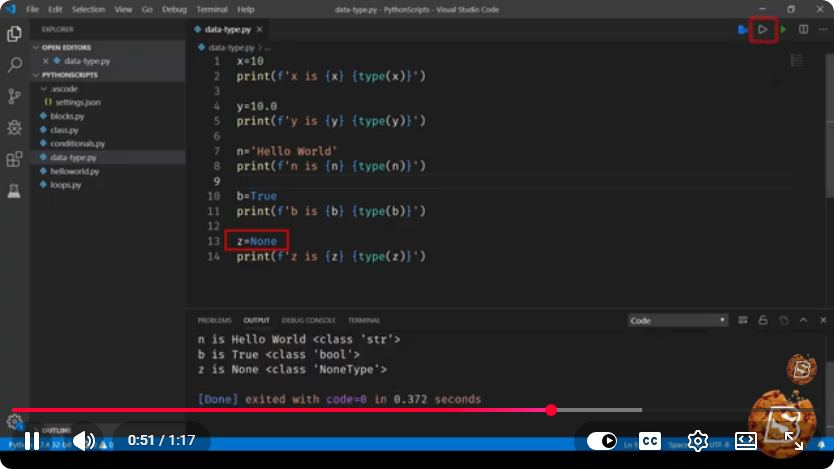
- None Type
Let’s delve deeper into each category.
Numeric Types
Python has two main numeric types:
Integers: Whole numbers, both positive and negative, without any decimal points.
age = 30 temperature = -5Floats: Numbers that contain decimal points.
height = 5.9
weight = 72.5
Python also supports complex numbers, which consist of a real and an imaginary part:
complex_number = 2 + 3j
Sequence Types
Sequence types allow you to store collections of items. The most commonly used sequence types are:
Strings: A sequence of characters. Strings can be defined using single, double, or triple quotes.
greeting = "Hello, World!"Lists: Ordered, mutable collections of items that can be of varied data types.
fruits = ["apple", "banana", "cherry"]Tuples: Similar to lists, but immutable. Once created, their content cannot be changed.
colors = ("red", "green", "blue")
Mapping Types
- Dictionaries: Unordered collections of key-value pairs. They are mutable and can hold mixed data types.
student = {
    "name": "John",
    "age": 21,
    "major": "Computer Science"
}
Set Types
- Sets: Unordered collections of unique items. They are mutable and are used to perform mathematical set operations.
unique_numbers = {1, 2, 3, 4, 5}
Boolean Type
- Booleans: This type represents one of two values:
TrueorFalse. Booleans are often used in conditional statements.is_active = True has_access = False
None Type
- NoneType: The special type
Nonerepresents the absence of a value or a null value.response = None
Conclusion
Understanding Python data types is crucial for effective programming. Each data type serves specific purposes and has its own set of operations and methods you can use. By mastering these essentials, you will lay a solid foundation for more advanced programming concepts.
As you continue your Python journey, make sure to experiment with these data types in your code. Practice is key to becoming proficient in programming. Happy coding!
Connect with SkillBakery Studios
Explore more tutorials, tools, and resources:
Posted by SkillBakery Studios


 Hello, my name is Jack Sparrow. I'm a 50 year old self-employed Pirate from the Caribbean.
No comments:
Post a Comment