
21. Python Essentials: Arithmetic Operators in Python: Performing Mathematical Operations with Ease
Python Essentials: Understanding Arithmetic Operators in Python
In the world of programming, arithmetic operators are foundational tools that allow us to perform mathematical operations. In Python, these operators are straightforward to use and provide a powerful way to manipulate numerical data. In this tutorial, we'll explore the various arithmetic operators available in Python and demonstrate how to use them effectively.
What are Arithmetic Operators?
Arithmetic operators are symbols that perform specific mathematical operations on numerical values (also known as operands). Python, like many programming languages, provides a set of built-in arithmetic operators that you can use in your code.
Common Arithmetic Operators in Python
Here’s a quick overview of the arithmetic operators available in Python:
| Operator | Description | Example |
|---|---|---|
+ |
Addition | 5 + 3 |
- |
Subtraction | 5 - 3 |
* |
Multiplication | 5 * 3 |
/ |
Division | 5 / 3 |
// |
Floor Division | 5 // 3 |
% |
Modulus (Remainder) | 5 % 3 |
** |
Exponentiation | 5 ** 3 |
Using Arithmetic Operators
Let's take a closer look at each arithmetic operator with examples.
Addition (+)
The addition operator is used to add two numbers together.
a = 10
b = 5
result = a + b
print(result)  # Output: 15
Subtraction (-)
The subtraction operator subtracts one number from another.
a = 10
b = 5
result = a - b
print(result)  # Output: 5
Multiplication (*)
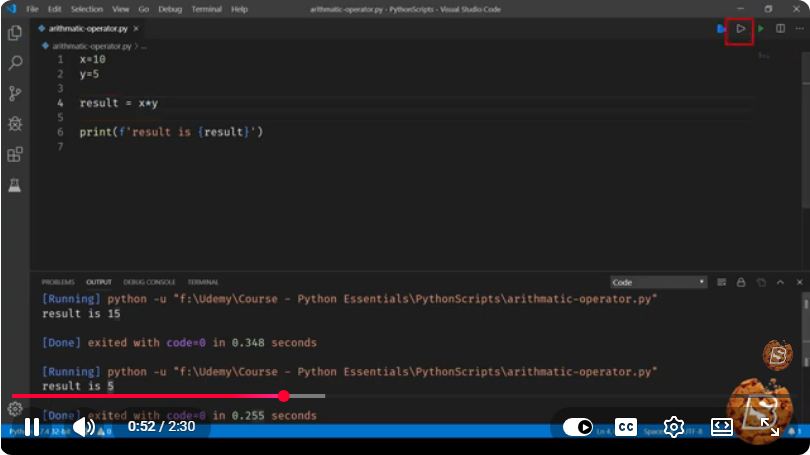
The multiplication operator multiplies two numbers.
a = 10
b = 5
result = a * b
print(result)  # Output: 50
Division (/)
The division operator divides one number by another and returns a float.
a = 10
b = 3
result = a / b
print(result)  # Output: 3.3333333333333335
Floor Division (//)
Floor division divides and rounds down to the nearest whole number.
a = 10
b = 3
result = a // b
print(result)  # Output: 3
Modulus (%)
The modulus operator returns the remainder of a division operation.
a = 10
b = 3
result = a % b
print(result)  # Output: 1
Exponentiation (**)
The exponentiation operator raises one number to the power of another.
a = 2
b = 3
result = a ** b
print(result)  # Output: 8
Combining Operators
You can combine multiple arithmetic operators in a single expression. Python follows the order of operations (PEMDAS/BODMAS) to evaluate these expressions, which means it will prioritize operations in the following order: Parentheses, Exponents, Multiplication and Division (from left to right), and Addition and Subtraction (from left to right).
result = (2 + 3) * 4 - 6 / 2
print(result)  # Output: 19.0
Conclusion
Arithmetic operators in Python are both powerful and easy to use. Mastering these operators is essential for performing mathematical computations and building complex algorithms. With the knowledge gained from this tutorial, you can confidently apply arithmetic operations in your Python projects.
Feel free to experiment with different combinations of these operators to see how they work together. Happy coding!
Connect with SkillBakery Studios
Explore more tutorials, tools, and resources:
Posted by SkillBakery Studios


 Hello, my name is Jack Sparrow. I'm a 50 year old self-employed Pirate from the Caribbean.
No comments:
Post a Comment