
57. Python Essentials: Built-in Numeric Functions in Python
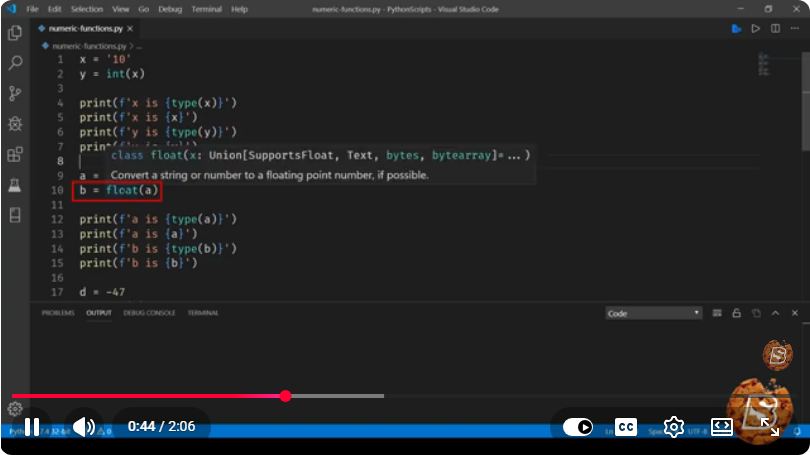
Python Essentials: Built-in Numeric Functions
In the world of programming, especially with Python, understanding numeric functions is crucial for performing calculations and manipulating numbers efficiently. In this blog post, we will explore the built-in numeric functions available in Python, providing examples and explanations to help you grasp their usage quickly.
What are Built-in Numeric Functions?
Built-in numeric functions in Python are pre-defined functions that allow you to perform mathematical operations without having to implement these functions from scratch. They can handle integers, floats, and complex numbers, making them versatile tools in any Python programmer's toolkit.
Common Numeric Functions
Here are some of the most commonly used built-in numeric functions in Python:
abs()round()pow()min()max()sum()divmod()
Let's take a closer look at each of these functions.
1. abs()
The abs() function returns the absolute value of a number. This means it converts any negative number to its positive counterpart.
Example:
print(abs(-5))   # Output: 5
print(abs(3.14)) # Output: 3.14
2. round()
The round() function rounds a number to the nearest integer or to a specified number of decimal places.
Example:
print(round(3.14159))     # Output: 3
print(round(3.14159, 2))  # Output: 3.14
3. pow()
The pow() function returns the value of a number raised to a specified power. It can also take a third argument to compute the modulus.
Example:
print(pow(2, 3))          # Output: 8
print(pow(2, 3, 3))       # Output: 2 (since 8 % 3 = 2)
4. min()
The min() function returns the smallest of the input numbers. It can take multiple arguments or a single iterable.
Example:
print(min(3, 1, 4, 2))             # Output: 1
print(min([10, 20, 30, 5, 15]))    # Output: 5
5. max()
Conversely, the max() function returns the largest of the input numbers.
Example:
print(max(3, 1, 4, 2))             # Output: 4
print(max([10, 20, 30, 5, 15]))    # Output: 30
6. sum()
The sum() function returns the sum of all elements in an iterable, such as a list or tuple.
Example:
print(sum([1, 2, 3, 4, 5]))        # Output: 15
print(sum((10, 20, 30), 5))         # Output: 65 (adds 5 to the sum)
7. divmod()
The divmod() function takes two numbers and returns a tuple consisting of their quotient and remainder.
Example:
print(divmod(8, 3)) # Output: (2, 2) (2 is the quotient and 2 is the remainder)
Conclusion
Understanding these built-in numeric functions in Python can significantly enhance your programming capabilities. They offer a straightforward way to perform common mathematical operations and are optimized for performance, making your code cleaner and more efficient.
Whether you're a beginner or looking to refresh your knowledge, mastering these functions will provide a solid foundation for more advanced programming concepts in Python. Happy coding!
Connect with SkillBakery Studios
Explore more tutorials, tools, and resources:
Posted by SkillBakery Studios


 Hello, my name is Jack Sparrow. I'm a 50 year old self-employed Pirate from the Caribbean.
No comments:
Post a Comment