
8-Zero-Shot vs Few-Shot Learning Explained | Fun AI Example with Rhymes
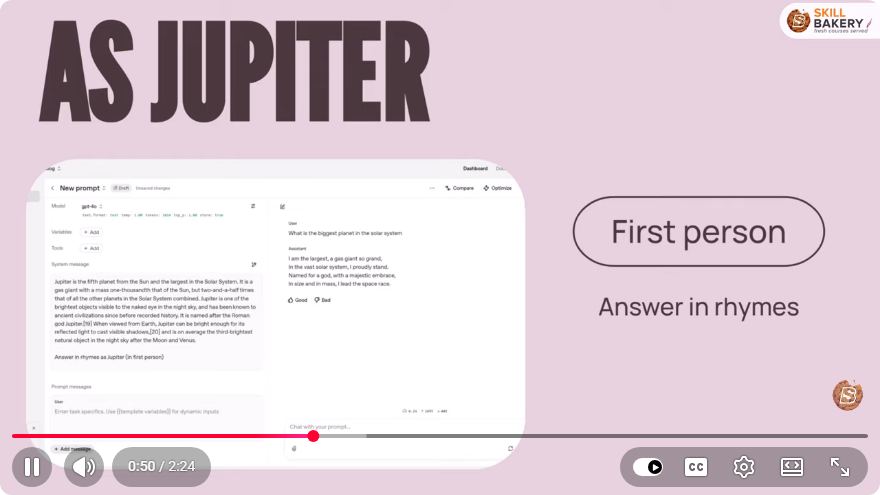
Understanding Zero-Shot and Few-Shot Learning in AI: A Fun Exploration with Rhymes
Artificial Intelligence (AI) is evolving rapidly, and one of the most intriguing aspects of machine learning is its ability to learn from data. Two powerful techniques in this domain are zero-shot learning and few-shot learning. In this blog post, we’ll break down these concepts using a fun example: transforming a paragraph about Jupiter into a Q&A bot that responds in rhyme.
What is Zero-Shot Learning?
Zero-shot learning (ZSL) refers to the ability of an AI model to recognize and understand tasks or categories that it has never seen before. Essentially, the model is tasked with making predictions or classifications without having any prior examples of those tasks during its training phase.
Example of Zero-Shot Learning
Imagine an AI model that has been trained to understand facts about various planets but has never been explicitly trained on Jupiter. If you ask it a question about Jupiter, it should be able to provide a relevant answer based on its knowledge of planetary characteristics, even though it has no specific training on that planet.
Illustration:
- Input: "What is Jupiter known for?"
- Output: "Jupiter is the giant, with storms so grand, the Great Red Spot is where winds take a stand."
In this example, the model generates a rhymed response without having learned specifically about Jupiter's characteristics through examples.
What is Few-Shot Learning?
Few-shot learning (FSL), on the other hand, allows a model to learn new tasks with just a handful of examples. This technique is particularly useful when collecting large datasets for training is impractical or impossible.
Example of Few-Shot Learning
Let’s say we want the AI to answer questions about a new planet, say Mars, but we only provide it with a couple of examples:
- Example 1: "Mars is the red planet, its surface is dry."
- Example 2: "With Olympus Mons, it's the tallest mountain in the sky."
With these two examples, the model can learn to generate responses about Mars, applying its knowledge of rhymes.
Illustration:
- Input: "Tell me something about Mars."
- Output: "Mars is known for its reddish glow, with canyons and valleys that put on a show."
Key Differences Between Zero-Shot and Few-Shot Learning
| Feature | Zero-Shot Learning | Few-Shot Learning |
|---|---|---|
| Training Examples | None for specific tasks | A few examples provided |
| Adaptability | High, can generalize to unseen tasks | Moderate, relies on provided examples |
| Data Requirement | Zero labeled examples needed | Limited labeled examples needed |
| Use Cases | Language translation, image recognition | Personalized assistants, specialized tasks |
Creating a Rhyming Q&A Bot
Now, let’s see how we can implement these concepts in a simple Q&A bot that answers in rhymes.
Step 1: Setting Up the Environment
To create our bot, you’ll need Python and a few libraries. Here’s a basic setup:
pip install nltk
Step 2: Define the Rhyming Logic
We will use the Natural Language Toolkit (NLTK) to help with generating rhymes.
import nltk
from nltk.corpus import cmudict

# Download CMU Pronouncing Dictionary
nltk.download('cmudict')
pronouncing_dict = cmudict.dict()

def find_rhymes(word):
    rhymes = []
    if word.lower() in pronouncing_dict:
        word_syllables = pronouncing_dict[word.lower()]
        for key in pronouncing_dict.keys():
            if pronouncing_dict[key] == word_syllables:
                rhymes.append(key)
    return rhymes
Step 3: Generate Rhymed Responses
Now that we have a function to find rhymes, we can create our bot logic.
def generate_rhyme_response(question, fact):
    # For simplicity, we'll just use the last word of the fact
    last_word = fact.split()[-1]
    rhymes = find_rhymes(last_word)
    if rhymes:
        response = f"{fact} And it rhymes with {', '.join(rhymes[:3])}!"
    else:
        response = "Sorry, I couldn't find a rhyme!"
    return response
Step 4: Putting It All Together
Finally, let’s create a simple interaction loop for our bot.
def main():
    facts = {
        "Jupiter": "Jupiter is the largest planet in our solar system.",
        "Mars": "Mars is known for its reddish glow."
    }

    while True:
        question = input("Ask me about a planet (or type 'exit' to quit): ")
        if question.lower() == 'exit':
            break
        planet = question.split()[-1].capitalize()  # Assuming the last word is the planet
        if planet in facts:
            response = generate_rhyme_response(question, facts[planet])
            print(response)
        else:
            print("I don't know about that planet yet.")

if __name__ == "__main__":
    main()
Conclusion
Understanding zero-shot and few-shot learning can greatly enhance the capabilities of AI models. By leveraging these techniques, we can create intelligent systems that are adaptable, even in situations where data is scarce. In our fun example of a rhyming Q&A bot, we illustrated how these concepts can be applied in practice.
As AI continues to evolve, the potential applications for zero-shot and few-shot learning will only expand. Whether you're interested in chatbot development, natural language processing, or another area, mastering these techniques will undoubtedly serve you well in the rapidly changing landscape of AI.
Connect with SkillBakery Studios
Explore more tutorials, tools, and resources:
Posted by SkillBakery Studios


 Hello, my name is Jack Sparrow. I'm a 50 year old self-employed Pirate from the Caribbean.
No comments:
Post a Comment