
Data Structures in C# - Exploring ShellSort
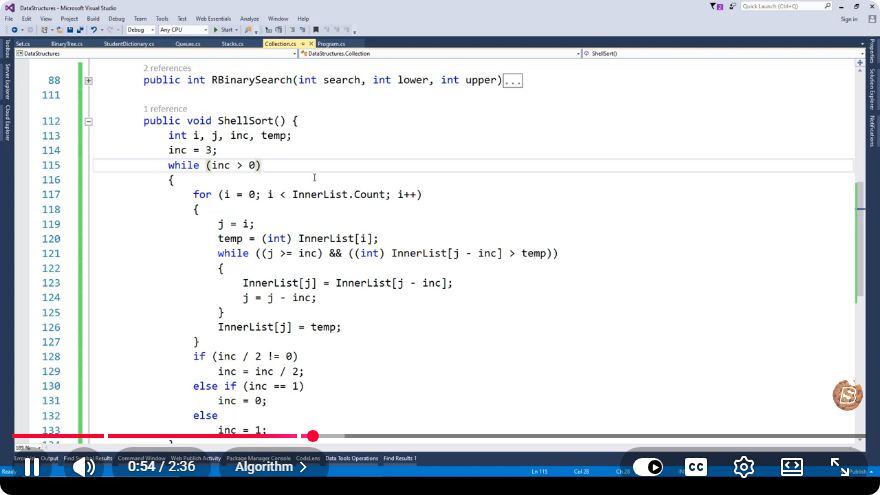
Data Structures in C#: Exploring ShellSort
Data structures are foundational components in computer science, enabling us to organize and manipulate data efficiently. Among the various sorting algorithms, ShellSort stands out for its performance and simplicity. In this blog post, we'll explore ShellSort in the context of C#, providing a clear understanding of its workings, implementation, and performance characteristics.
What is ShellSort?
ShellSort is an in-place comparison-based sorting algorithm that generalizes insertion sort to allow the exchange of items that are far apart. The algorithm is named after its inventor, Donald Shell, and it was introduced in 1959. It improves the efficiency of insertion sort by allowing the exchange of distant elements, reducing the total number of movements needed to sort the array.
How does ShellSort work?
ShellSort starts by arranging the array elements at specific intervals or "gaps." The algorithm sorts elements that are a certain gap distance apart. With successive iterations, the gap is reduced until it becomes 1, at which point the algorithm performs a standard insertion sort. The main advantage of this approach is that it allows elements to move closer to their final sorted position more quickly than a simple insertion sort.
Steps to Implement ShellSort in C#
Now that we have a basic understanding of ShellSort, let's implement it in C#. Below is a step-by-step guide on how to do that.
Step 1: Define the ShellSort Method
We will create a method named ShellSort that takes an array of integers as an input parameter and sorts it.
public void ShellSort(int[] arr)
{
    int n = arr.Length;
    // Start with a big gap, then reduce the gap
    for (int gap = n / 2; gap > 0; gap /= 2)
    {
        // Do a gapped insertion sort for this gap size
        for (int i = gap; i < n; i++)
        {
            // Save arr[i] in temp and make a hole at position i
            int temp = arr[i];
            int j;
            // Shift earlier gap-sorted elements up until the correct location for arr[i] is found
            for (j = i; j >= gap && arr[j - gap] > temp; j -= gap)
            {
                arr[j] = arr[j - gap];
            }
            // Put temp (the original arr[i]) in its correct location
            arr[j] = temp;
        }
    }
}
Step 2: Testing the ShellSort Implementation
After defining the ShellSort method, we need to test its functionality. Let’s create a simple program that initializes an array, sorts it using ShellSort, and then prints the sorted array.
class Program
{
    static void Main(string[] args)
    {
        int[] arr = { 12, 34, 54, 2, 3 };
        Console.WriteLine("Original array:");
        PrintArray(arr);

        ShellSort(arr);

        Console.WriteLine("Sorted array:");
        PrintArray(arr);
    }

    public static void PrintArray(int[] arr)
    {
        foreach (var item in arr)
        {
            Console.Write(item + " ");
        }
        Console.WriteLine();
    }

    public static void ShellSort(int[] arr)
    {
        // Implementation as shown previously
    }
}
Step 3: Running the Program
When you run the above program, it will display the original array and the sorted array as output. You should see the following result:
Original array:
12 34 54 2 3
Sorted array:
2 3 12 34 54
Performance Characteristics of ShellSort
ShellSort has a time complexity that depends on the gap sequence used. The average-case time complexity is typically around (O(n^{1.5})), but it can vary. The worst-case time complexity can reach (O(n^2)) if a poor gap sequence is chosen. However, with a good gap sequence, it can perform quite efficiently.
Advantages of ShellSort
- Increased Efficiency: Compared to simple algorithms like insertion sort, ShellSort performs better for larger datasets.
- In-Place Sorting: It requires a constant amount of additional space, making it memory efficient.
- Adaptive: It can be optimized based on the existing order of elements.
Disadvantages of ShellSort
- Not Stable: The algorithm does not preserve the order of equal elements.
- Complexity of Gap Sequences: The choice of gap sequences can significantly affect performance, which can be a drawback for beginners.
Conclusion
In this blog post, we explored ShellSort, a fascinating sorting algorithm within the realm of data structures in C#. We implemented the algorithm step-by-step and demonstrated how to test it effectively. With its advantages in performance and efficiency, ShellSort is a valuable addition to your sorting toolkit.
For further learning, consider experimenting with different gap sequences and comparing performance results, or delve into other sorting algorithms to broaden your understanding of data structures. Happy coding!
Connect with SkillBakery Studios
Explore more tutorials, tools, and resources:
Posted by SkillBakery Studios


 Hello, my name is Jack Sparrow. I'm a 50 year old self-employed Pirate from the Caribbean.
No comments:
Post a Comment