
Web Developers : Craft Types Using Semigroups
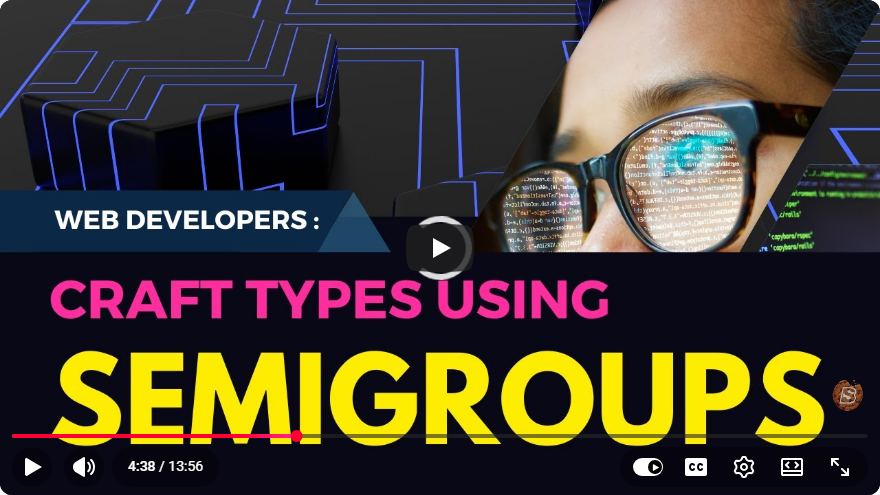
Crafting Types Using Semigroups: A Guide for Web Developers
In the realm of functional programming, semigroups offer a powerful abstraction that can greatly enhance your type system and lead to more maintainable code. In this post, we will explore the concept of semigroups, how they can be utilized in web development, and provide practical examples to illustrate their benefits.
What is a Semigroup?
A semigroup is a mathematical structure that consists of a set equipped with an associative binary operation. This means that for any three elements a, b, and c in the set, the following holds true:
(a * b) * c = a * (b * c)
Key Characteristics of Semigroups
- Closure: The operation must combine any two elements within the set to produce another element of the same set.
- Associativity: The grouping of operations does not affect the outcome.
Examples of Semigroups
- Numbers with Addition: The set of integers with the addition operation.
- Strings with Concatenation: The set of strings with the concatenation operation.
Why Use Semigroups in Web Development?
Semigroups can help manage complex data transformations and enable developers to write cleaner, more composable code. By leveraging semigroups, you can:
- Encapsulate behavior: Group related operations into a single type.
- Compose functions effortlessly: Utilize the associative property to combine functions without worrying about the order of operations.
- Improve code readability: Create a clear and concise representation of data manipulations.
Implementing Semigroups in TypeScript
Let’s dive into a practical example using TypeScript to implement a semigroup for a custom data type. In this scenario, we'll create a semigroup for a User type that merges user data.
Step 1: Define the User Type
interface User {
    name: string;
    age: number;
}
Step 2: Implement the Semigroup
Now let's implement the semigroup for our User type. We'll create a function that merges two User objects, prioritizing the non-null fields of the second user.
const userSemigroup = {
    concat: (userA: User, userB: User): User => {
        return {
            name: userB.name || userA.name,
            age: userB.age !== undefined ? userB.age : userA.age,
        };
    },
};
Step 3: Utilizing the Semigroup
You can now use the userSemigroup to merge user data seamlessly.
const user1: User = { name: "Alice", age: 25 };
const user2: User = { name: "", age: 30 };

const mergedUser = userSemigroup.concat(user1, user2);
console.log(mergedUser); // Output: { name: "Alice", age: 30 }
Composing Multiple Users
Using the semigroup, you can easily merge multiple user objects:
const users = [
    { name: "Alice", age: 25 },
    { name: "Bob", age: 30 },
    { name: "Charlie", age: 35 },
];

const mergedUsers = users.reduce(userSemigroup.concat);
console.log(mergedUsers); // Output: { name: "Alice", age: 35 }
Conclusion
Semigroups are a powerful concept that can lead to cleaner and more maintainable code in web development. By encapsulating behavior and enabling effortless composition, they allow developers to manage complexity effectively.
In this post, we covered the definition of semigroups, their relevance in web development, and a practical TypeScript implementation. We hope you now have a better understanding of how to utilize semigroups in your projects!
Further Reading
Feel free to leave your thoughts in the comments below or share your experiences using semigroups in your own projects!
Connect with SkillBakery Studios
Explore more tutorials, tools, and resources:
Posted by SkillBakery Studios


 Hello, my name is Jack Sparrow. I'm a 50 year old self-employed Pirate from the Caribbean.
No comments:
Post a Comment