
16. Python Essentials: The Boolean Type in Python: Exploring True and False Values
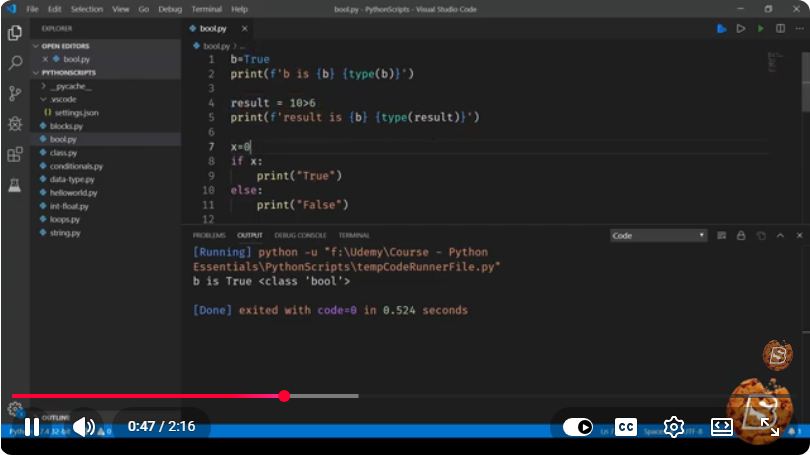
Understanding the Boolean Type in Python: Exploring True and False Values
In the world of programming, the ability to represent truth and falsehood is fundamental. In Python, this is achieved through the Boolean data type, which consists of two values: True and False. In this post, we will explore the Boolean type, its significance, and how to effectively use it in Python programming.
What is a Boolean?
A Boolean is a data type that can hold one of two possible values: True or False. Named after the mathematician George Boole, Booleans are crucial in making decisions within your code. They are often used in conditional statements, loops, and logical operations.
Why Use Booleans?
Booleans enable control flow in your programs. By evaluating conditions, they dictate which blocks of code should execute based on whether a condition is True or False. This capability allows for more dynamic and flexible programs.
Creating Boolean Values in Python
In Python, you can create Boolean values directly using the keywords True and False. Here’s how:
is_active = True
has_access = False
In the example above, is_active is set to True, indicating that a certain condition is met, while has_access is False, suggesting a restriction.
Evaluating Conditions
Booleans often arise from comparisons and logical operations. The following comparison operators return a Boolean value:
==(equal to)!=(not equal to)>(greater than)<(less than)>=(greater than or equal to)<=(less than or equal to)
Example of Comparison
a = 10
b = 20

is_equal = a == b  # False
is_greater = a > b  # False
is_less = a < b  # True
In this snippet, the expressions evaluate to Boolean values based on the comparison between a and b.
Logical Operations with Booleans
Python supports three logical operations that combine Boolean values: and, or, and not.
andreturnsTrueif both operands areTrue.orreturnsTrueif at least one operand isTrue.notinverts the Boolean value.
Example of Logical Operations
is_logged_in = True
is_admin = False

can_access = is_logged_in and is_admin  # False
can_access_any = is_logged_in or is_admin  # True
not_logged_in = not is_logged_in  # False
In this example, the logical operations help determine access conditions based on user status.
Conditional Statements and Booleans
Booleans are commonly used in conditional statements such as if, elif, and else. These statements execute specific blocks of code depending on the truthiness of a condition.
Example of a Conditional Statement
user_age = 18

if user_age >= 18:
    print("You are eligible to vote.")
else:
    print("You are not eligible to vote.")
Here, the program checks if user_age is greater than or equal to 18 and prints a message based on the condition.
Conclusion
The Boolean type is a cornerstone of control flow in Python programming. By utilizing True and False, along with comparison and logical operations, you can create dynamic and responsive applications. Understanding how to effectively use Booleans will enhance your programming skills and enable you to write more efficient code.
Further Reading
To deepen your understanding of the Boolean type and its applications, consider exploring the following topics:
- Conditional statements in Python
- Logical operators and their combinations
- Truthiness in Python
By mastering these concepts, you will be well on your way to becoming proficient in Python programming!
If you have any questions or comments regarding Booleans in Python, feel free to ask below!
Connect with SkillBakery Studios
Explore more tutorials, tools, and resources:
Posted by SkillBakery Studios


 Hello, my name is Jack Sparrow. I'm a 50 year old self-employed Pirate from the Caribbean.
No comments:
Post a Comment