
32. Python Essentials: Function Argument List in Python
Understanding Function Argument Lists in Python
In Python, functions are a fundamental building block that allows us to encapsulate code into reusable units. One of the key aspects of defining functions is understanding how to work with function argument lists. This blog post will provide a detailed overview of function argument lists in Python, showcasing how to effectively utilize them for optimal coding practices.
What is a Function Argument List?
A function argument list includes the parameters that a function can accept when it is called. These parameters can be specified in various ways, allowing for flexibility in how functions are utilized. Understanding how to define and use these arguments is essential for writing clean and efficient code.
Basic Function Definition
At its core, a function in Python is defined using the def keyword, followed by the function name and a set of parentheses that contain the argument list. Here’s a simple example:
def greet(name):
    print(f"Hello, {name}!")
In this example, greet is a function that takes a single argument, name. When called, it will print a greeting message.
Default Arguments
Python allows you to specify default values for function arguments. If no argument is provided when the function is called, the default value is used. Here's how it works:
def greet(name="Guest"):
    print(f"Hello, {name}!")

greet()          # Output: Hello, Guest!
greet("Alice")  # Output: Hello, Alice!
In this example, if greet is called without an argument, it defaults to "Guest".
Keyword Arguments
Keyword arguments allow you to specify parameters by name when calling a function. This can improve code clarity, especially with functions that have multiple parameters:
def introduce(name, age):
    print(f"My name is {name} and I am {age} years old.")

introduce(age=30, name="Bob")  # Output: My name is Bob and I am 30 years old.
Here, using keyword arguments allows us to call the function in any order.
Variable-Length Arguments
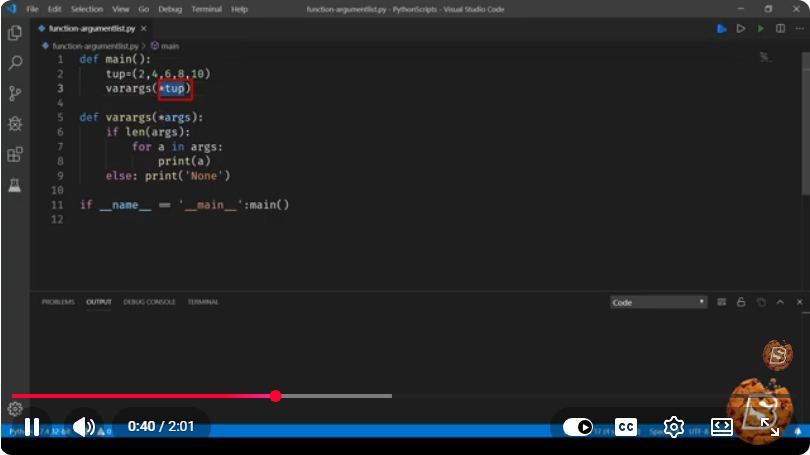
Sometimes, you may not know in advance how many arguments will be passed to a function. Python provides two ways to handle variable-length arguments: *args for non-keyword arguments and **kwargs for keyword arguments.
Using *args
The *args syntax allows you to pass a variable number of positional arguments to a function. These arguments are received as a tuple:
def add_numbers(*args):
    return sum(args)

print(add_numbers(1, 2, 3))  # Output: 6
print(add_numbers(10, 20))    # Output: 30
In this example, add_numbers can take any number of arguments and return their sum.
Using **kwargs
Similarly, **kwargs allows you to pass a variable number of keyword arguments. These are received as a dictionary:
def print_info(**kwargs):
    for key, value in kwargs.items():
        print(f"{key}: {value}")

print_info(name="Alice", age=30, city="New York")
This function will output:
name: Alice
age: 30
city: New York
Conclusion
Understanding function argument lists is crucial for writing effective Python code. By using default arguments, keyword arguments, and variable-length arguments, you can create flexible functions that cater to various needs. This enables your code to be more reusable and easier to read.
Start implementing these concepts in your Python projects to enhance your coding skills and improve the functionality of your programs. Happy coding!
Connect with SkillBakery Studios
Explore more tutorials, tools, and resources:
Posted by SkillBakery Studios


 Hello, my name is Jack Sparrow. I'm a 50 year old self-employed Pirate from the Caribbean.
No comments:
Post a Comment