
41. Python Essentials: List Comprehension Unleashed
Python Essentials: Mastering List Comprehension
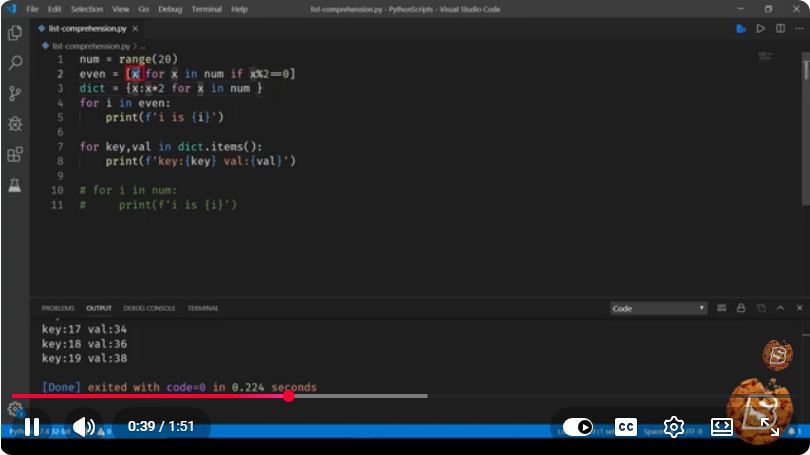
List comprehension is one of the most powerful features in Python, allowing for the creation of lists in a concise and readable manner. In this blog post, we’ll explore the fundamentals of list comprehension, its syntax, and practical examples that demonstrate its utility in everyday coding tasks.
What is List Comprehension?
List comprehension provides a succinct way to create lists by iterating over an iterable (like a list, tuple, or string) and applying an expression to each element. It can replace the need for traditional loops and is often more readable and efficient.
Basic Syntax
The basic syntax of list comprehension is as follows:
[expression for item in iterable if condition]
- expression: The value to be added to the list.
- item: The current element being processed from the iterable.
- iterable: A collection of items (e.g., a list).
- condition (optional): A filter that determines whether the expression is added to the list.
Creating a Simple List with List Comprehension
Let’s start with a straightforward example. Suppose we want to create a list of squares for the numbers from 0 to 9. Traditionally, we might do this using a loop:
squares = []
for x in range(10):
    squares.append(x ** 2)
With list comprehension, we can accomplish the same task in a single line:
squares = [x ** 2 for x in range(10)]
Breaking It Down
In this example:
- The expression is
x ** 2, which calculates the square of each number. - The iterable is
range(10), which generates numbers from 0 to 9.
Adding Conditions to List Comprehension
List comprehension can also include conditions to filter items. For instance, if we only want the squares of even numbers, we can modify our previous example:
even_squares = [x ** 2 for x in range(10) if x % 2 == 0]
Explanation
Here, we've added a condition (if x % 2 == 0) which checks if a number is even. As a result, even_squares will contain:
[0, 4, 16, 36, 64]
Nesting List Comprehensions
List comprehension can also be nested. Let’s say we want to create a list of tuples representing coordinates in a 2D grid:
coordinates = [(x, y) for x in range(3) for y in range(3)]
Result
The variable coordinates will hold the following list:
[(0, 0), (0, 1), (0, 2), (1, 0), (1, 1), (1, 2), (2, 0), (2, 1), (2, 2)]
Practical Use Cases of List Comprehension
1. Transforming Data
List comprehension is excellent for transforming data. For example, converting a list of strings to uppercase:
words = ['hello', 'world', 'python']
uppercased_words = [word.upper() for word in words]
2. Filtering Data
You can also use list comprehension to filter data. For instance, extracting only the positive numbers from a list:
numbers = [-10, 5, 0, 15, -3]
positive_numbers = [num for num in numbers if num > 0]
3. Flattening a List of Lists
If you have a list of lists and you want to flatten it into a single list, you can use:
nested_list = [[1, 2, 3], [4, 5], [6, 7, 8]]
flat_list = [item for sublist in nested_list for item in sublist]
Conclusion
List comprehension is a powerful tool in Python that enhances code readability and efficiency. By mastering this feature, you can simplify your code and make it more Pythonic. Whether you're transforming, filtering, or flattening lists, list comprehension is an essential skill for any Python developer.
Embrace this technique, and you'll find it an invaluable addition to your coding toolkit! Happy coding!
Connect with SkillBakery Studios
Explore more tutorials, tools, and resources:
Posted by SkillBakery Studios


 Hello, my name is Jack Sparrow. I'm a 50 year old self-employed Pirate from the Caribbean.
No comments:
Post a Comment