
Data Structures in C# - Exploring Selection Sort
Data Structures in C#: Exploring Selection Sort
In the world of computer science, understanding data structures and algorithms is paramount for efficient programming. One fundamental algorithm that every programmer should be familiar with is Selection Sort. In this blog post, we will delve into the Selection Sort algorithm implemented in C#, exploring its mechanics, complexities, and practical applications.
What is Selection Sort?
Selection Sort is a simple and intuitive sorting algorithm that operates by repeatedly selecting the smallest (or largest) element from the unsorted part of the array and swapping it with the first unsorted element. This process continues until the entire array is sorted.
How Selection Sort Works
The algorithm can be broken down into the following steps:
- Start with the first element of the array as the minimum.
- Compare this minimum with the other elements in the array to find the smallest element.
- Swap the smallest found element with the first element.
- Move the boundary of the sorted and unsorted regions one element to the right.
- Repeat the process until the entire array is sorted.
Visual Example
Let's consider an example with the following array:
[64, 25, 12, 22, 11]
- In the first iteration, the smallest element (11) is selected and swapped with 64:
[11, 25, 12, 22, 64]. - In the second iteration, the smallest element (12) is swapped with 25:
[11, 12, 25, 22, 64]. - This process continues until the array is fully sorted.
Selection Sort Implementation in C#
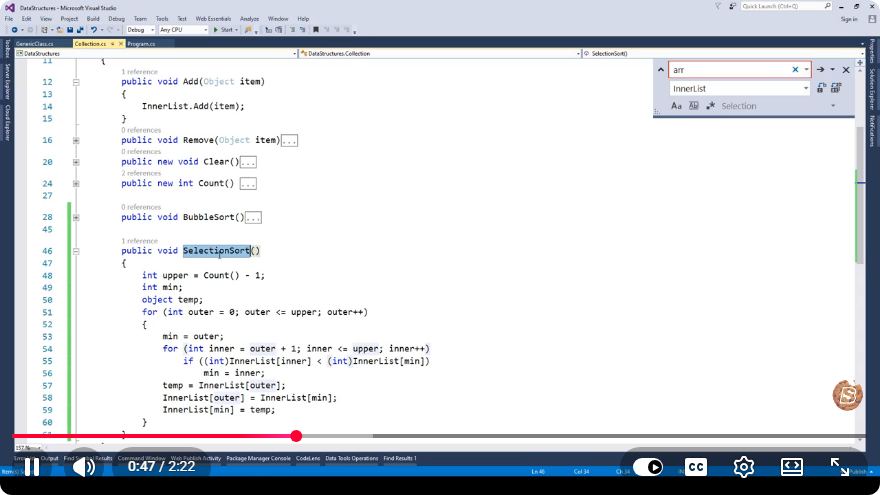
Now that we have a conceptual understanding of Selection Sort, let's implement it in C#. Below is a simple implementation of the Selection Sort algorithm:
using System;

class SelectionSortExample
{
    static void SelectionSort(int[] array)
    {
        int n = array.Length;

        for (int i = 0; i < n - 1; i++)
        {
            // Assume the minimum is the first element
            int minIndex = i;

            // Check the rest of the array for a smaller element
            for (int j = i + 1; j < n; j++)
            {
                if (array[j] < array[minIndex])
                {
                    minIndex = j;
                }
            }

            // Swap the found minimum element with the first element
            if (minIndex != i)
            {
                int temp = array[minIndex];
                array[minIndex] = array[i];
                array[i] = temp;
            }
        }
    }

    static void Main()
    {
        int[] array = { 64, 25, 12, 22, 11 };
        Console.WriteLine("Unsorted array: " + string.Join(", ", array));

        SelectionSort(array);

        Console.WriteLine("Sorted array: " + string.Join(", ", array));
    }
}
Code Explanation
- Function Definition: We define a method
SelectionSortthat takes an integer array as an argument. - Outer Loop: The outer loop iterates through each element, treating it as the current boundary of the sorted array.
- Inner Loop: The inner loop searches for the minimum element in the unsorted portion of the array.
- Swapping: If a smaller element is found, it is swapped with the current element at the boundary.
- Main Method: The
Mainmethod initializes an unsorted array, prints it, calls the sorting function, and then prints the sorted array.
Time and Space Complexity
Understanding the efficiency of algorithms is crucial. Selection Sort has the following complexities:
Time Complexity:
- Best Case: O(n²)
- Average Case: O(n²)
- Worst Case: O(n²)
Space Complexity: O(1) (in-place sorting).
Selection Sort is not the most efficient sorting algorithm for large datasets, primarily due to its O(n²) time complexity. However, its simplicity and ease of implementation make it a popular choice for educational purposes and small datasets.
When to Use Selection Sort
While Selection Sort may not be the best choice for large datasets, it can be beneficial in scenarios such as:
- Educational purposes to understand sorting algorithms.
- When memory usage is a primary concern since it operates in-place.
- Sorting small arrays where the overhead of more complex algorithms may not be justified.
Conclusion
Selection Sort is a fundamental algorithm that highlights the principles of sorting and algorithm design. Although it is not efficient for large datasets, its simplicity makes it an excellent starting point for learning about sorting algorithms. We encourage you to experiment with the provided C# code and explore how Selection Sort operates on different datasets.
Happy coding!
Connect with SkillBakery Studios
Explore more tutorials, tools, and resources:
Posted by SkillBakery Studios


 Hello, my name is Jack Sparrow. I'm a 50 year old self-employed Pirate from the Caribbean.
No comments:
Post a Comment