
Getting Started with Laravel : Laravel Dependency Injection: Fundamentals & Best Practices
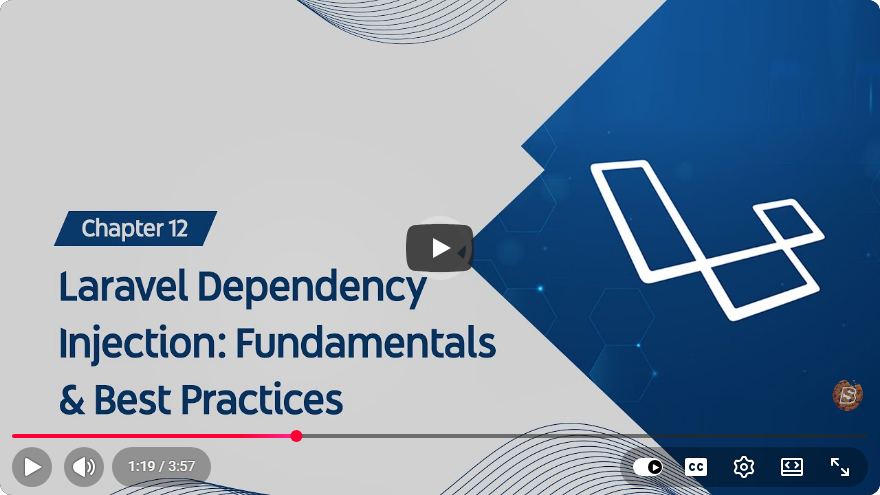
Getting Started with Laravel: Dependency Injection Fundamentals & Best Practices
Laravel is a powerful PHP framework that simplifies web application development. One of its core concepts is Dependency Injection (DI), a design pattern that enhances the flexibility and testability of your code. In this blog post, we will explore the fundamentals of Dependency Injection in Laravel and discuss best practices for implementing it effectively.
What is Dependency Injection?
Dependency Injection is a technique in software development where an object or function receives its dependencies from an external source rather than creating them itself. This approach promotes loose coupling, making your code easier to manage, test, and scale.
Benefits of Dependency Injection
- Improved Testability: By injecting dependencies, you can easily mock or stub them during unit testing.
- Easier Maintenance: Changes to dependencies require fewer code modifications, as they are decoupled from the components that use them.
- Enhanced Readability: Code becomes more understandable as the dependencies are clearly defined at the point of use.
How Laravel Implements Dependency Injection
Laravel provides a built-in service container that is responsible for managing class dependencies. The service container automatically resolves dependencies when you type-hint them in the constructor of your classes, controllers, or methods.
Constructor Injection
The most common method of Dependency Injection in Laravel is through constructor injection. Here's a simple example:
namespace App\Http\Controllers;

use App\Services\UserService;

class UserController extends Controller
{
    protected $userService;

    public function __construct(UserService $userService)
    {
        $this->userService = $userService;
    }

    public function index()
    {
        return $this->userService->getAllUsers();
    }
}
In this example, the UserController class type-hints the UserService class in its constructor. Laravel's service container automatically resolves the UserService instance and injects it into the controller.
Method Injection
Another way to use Dependency Injection in Laravel is through method injection. This is particularly useful for injecting dependencies into specific methods rather than the entire class. Here’s how it looks:
public function show(UserService $userService, $id)
{
    return $userService->findUserById($id);
}
In this case, UserService is injected directly into the show method, allowing you to use it without having it as a class property.
Best Practices for Dependency Injection in Laravel
1. Prefer Constructor Injection
While both constructor and method injection are valid, constructor injection is generally preferred for mandatory dependencies. It makes it clear what dependencies a class needs to function correctly.
2. Avoid Service Locator Pattern
While it might be tempting to use the service container as a locator (i.e., calling app() or resolve()), this practice can lead to tight coupling and make your code harder to test. Stick to constructor or method injection instead.
3. Limit Responsibilities
Ensure that your classes have a single responsibility. If a class requires too many dependencies, it might be a sign that it is doing too much and should be refactored into smaller classes.
4. Use Interfaces
When possible, type-hint interfaces rather than concrete classes. This allows for more flexibility and easier swapping of implementations, which is particularly useful in testing scenarios.
use App\Contracts\UserServiceInterface;

class UserController extends Controller
{
    protected $userService;

    public function __construct(UserServiceInterface $userService)
    {
        $this->userService = $userService;
    }
}
5. Document Dependencies
Always document the dependencies of your classes clearly. This not only helps other developers understand your code but also aids in maintaining and testing it.
Conclusion
Dependency Injection is a fundamental concept in Laravel that enhances your application's architecture. By understanding its principles and following best practices, you can create more maintainable, testable, and scalable applications. Whether you're new to Laravel or looking to refine your skills, mastering Dependency Injection is a crucial step on your development journey. Happy coding!
Connect with SkillBakery Studios
Explore more tutorials, tools, and resources:
Posted by SkillBakery Studios


 Hello, my name is Jack Sparrow. I'm a 50 year old self-employed Pirate from the Caribbean.
No comments:
Post a Comment