
How Long Does It Take to Become a Web Developer? (Day 3)
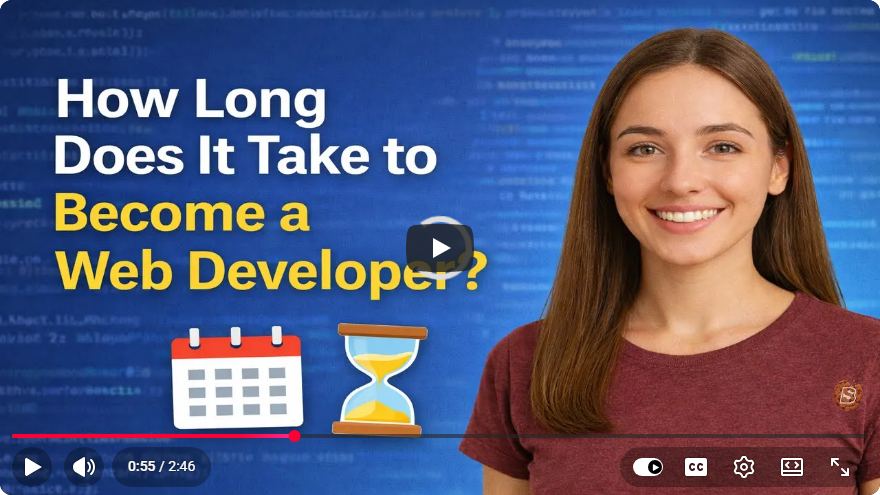
How Long Does It Take to Become a Web Developer?
If you've ever considered pursuing a career in web development, you've likely found yourself wondering about the timeline. With so many factors at play—from your prior knowledge to your learning speed and career aspirations—nailing down an exact timeframe can be tricky. In this blog post, we will break down realistic timelines for becoming a web developer based on insights from a recent YouTube video.
Understanding Web Development
Before diving into the timelines, let’s clarify what web development entails. Web development generally falls into three categories:
Front-End Development: This focuses on the visual aspects of a website that users interact with. Technologies involved include HTML, CSS, and JavaScript.
Back-End Development: This deals with the server-side of applications. It involves databases, server logic, and APIs. Common languages include Python, Ruby, PHP, and Java.
Full-Stack Development: This encompasses both front-end and back-end development, making you a versatile developer capable of building complete web applications.
Factors That Influence Your Timeline
1. Background Knowledge
Your starting point significantly impacts how long it will take you to become a web developer. Here are some scenarios:
Complete Beginner: If you have no prior knowledge of programming or web technologies, expect a longer learning curve. It may take anywhere from 6 months to 2 years to become job-ready.
Basic Understanding: If you have some familiarity with HTML and CSS but lack deeper knowledge, you might be looking at a timeline of 3 to 6 months, depending on how intensively you study.
Experienced Programmer: If you already know a programming language, transitioning to web development could take as little as 1 to 3 months, especially if you focus on the languages and frameworks relevant to web development.
2. Learning Pace
Your personal learning speed is another critical factor. Some people can grasp concepts quickly, while others may need more time to understand and apply the skills. Here are a few learning approaches:
Self-Directed Learning: Using online resources like tutorials, courses, and documentation can be flexible but may take longer without structured guidance.
Bootcamps: Intensive coding bootcamps typically last 3 to 6 months and offer a fast-tracked approach to becoming job-ready.
Formal Education: A degree program in computer science or a related field usually takes 2 to 4 years but provides a comprehensive foundation.
3. Career Goals
Your specific career goals also play a significant role in your timeline. For example:
Junior Developer: If your goal is to land a junior developer position, you may only need to master the fundamentals, which could take 3 to 6 months.
Specialized Roles: If you aim for a specialized role, such as a UX/UI designer or a back-end architect, you will need to invest additional time learning niche skills—potentially extending your timeline to 1 to 2 years.
Realistic Timelines
Based on the factors mentioned above, here are some realistic timelines:
- Complete Beginner: 6 to 24 months
- Basic Understanding: 3 to 6 months
- Experienced Programmer: 1 to 3 months
Final Thoughts
Embarking on a web development career is an exciting journey filled with opportunities for growth and creativity. While the timeline to become a web developer can vary widely based on your background, learning pace, and career goals, the important thing is to stay committed and keep learning.
Whether you choose to self-study, attend a bootcamp, or pursue a degree, remember that consistency is key. Regular practice and real-world projects will help solidify your skills and prepare you for the job market.
Happy coding!
Connect with SkillBakery Studios
Explore more tutorials, tools, and resources:
Posted by SkillBakery Studios


 Hello, my name is Jack Sparrow. I'm a 50 year old self-employed Pirate from the Caribbean.
No comments:
Post a Comment