
JavaScript ES6 - Default Parameter - Web Development
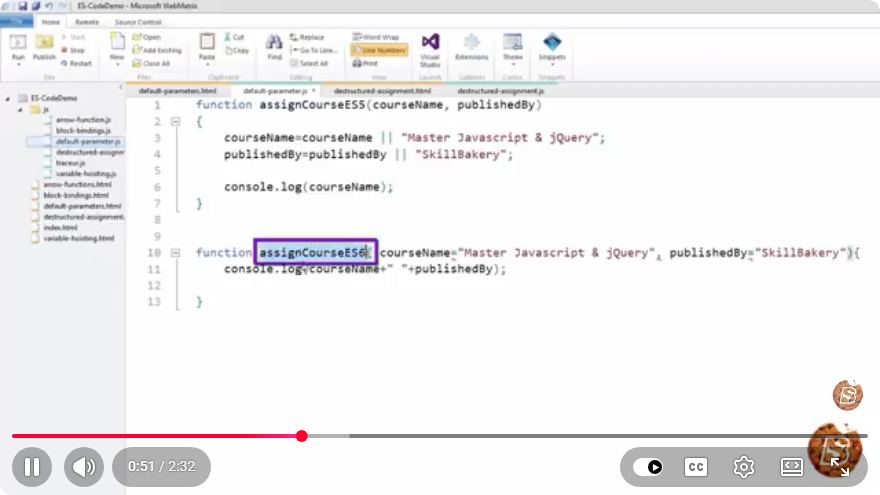
Understanding Default Parameters in JavaScript ES6
JavaScript, one of the most widely used programming languages, has undergone significant evolution since its inception. Among its many enhancements, ES6 (ECMAScript 2015) introduced a feature that simplifies function calls: default parameters. In this blog post, we will explore what default parameters are, how to use them, and why they are beneficial in web development.
What are Default Parameters?
Default parameters allow you to initialize function parameters with default values if no value or undefined is passed when the function is called. This enhances code readability and reduces the need for explicit checks within the function body.
Syntax
The syntax for defining default parameters is straightforward. Here is a basic example:
function greet(name = 'Guest') {
    return `Hello, ${name}!`;
}
In this example, the parameter name has a default value of 'Guest'. If the function greet is called without an argument, it will use this default value.
How to Use Default Parameters
Basic Example
Let’s see how default parameters work in practice:
function multiply(a, b = 1) {
    return a * b;
}

console.log(multiply(5));    // Output: 5
console.log(multiply(5, 2)); // Output: 10
In the multiply function, the parameter b has a default value of 1. When we call multiply(5), it returns 5 since b defaults to 1. When we explicitly provide a second argument, such as 2, it uses that value instead.
Multiple Parameters
You can also set default values for multiple parameters:
function createUser(name = 'Anonymous', age = 18) {
    return {
        name: name,
        age: age
    };
}

console.log(createUser()); // Output: { name: 'Anonymous', age: 18 }
console.log(createUser('Alice', 25)); // Output: { name: 'Alice', age: 25 }
In the createUser function, both name and age have default values. This allows you to create a user object without providing any arguments, thereby enhancing flexibility.
Benefits of Using Default Parameters
1. Simplifies Code
Default parameters eliminate the need for manual checks and assignments within the function. This leads to cleaner and more maintainable code.
2. Enhances Readability
Code with default parameters clearly communicates the intended use of the function. Anyone reading the function signature can easily understand the expected inputs.
3. Reduces Errors
By providing default values, you minimize the chances of errors caused by undefined values, leading to more robust code.
Important Considerations
While default parameters are useful, there are a few considerations to keep in mind:
Default parameters are evaluated at call time, meaning they can depend on other parameters.
function add(a, b = a) {
    return a + b;
}

console.log(add(5)); // Output: 10
Default parameters can be expressions, allowing for more complex defaults:
function power(base, exponent = base) {
    return base ** exponent;
}

console.log(power(2)); // Output: 4 (2^2)
Conclusion
Default parameters in JavaScript ES6 are a powerful feature that enhances function flexibility and readability. By utilizing this feature, developers can write cleaner code that is easier to understand and maintain.
As you continue to explore the features of ES6, consider how default parameters might simplify your functions and improve your overall coding practice. Happy coding!
Connect with SkillBakery Studios
Explore more tutorials, tools, and resources:
Posted by SkillBakery Studios


 Hello, my name is Jack Sparrow. I'm a 50 year old self-employed Pirate from the Caribbean.
No comments:
Post a Comment