
JavaScript ES6 - Destructuring Parameters - Web Devlopment
Understanding JavaScript ES6 Destructuring Parameters
In the realm of modern JavaScript development, especially with the introduction of ES6 (ECMAScript 2015), destructuring has become a powerful feature that simplifies the extraction of data from arrays and objects. In this blog post, we'll focus on one specific aspect: destructuring parameters in function definitions. This technique not only makes your code cleaner but also enhances readability and maintainability.
What is Destructuring?
Destructuring is a syntax that allows you to unpack values from arrays or properties from objects into distinct variables. It provides a more concise way to extract data without needing to access each property individually.
Why Use Destructuring Parameters?
When defining functions, you often need to pass multiple parameters. Destructuring allows you to pass an object as a single parameter and extract the required properties directly in the function signature. This approach helps in:
- Simplifying function signatures
- Enhancing code readability
- Reducing the need for additional variable declarations
Destructuring Object Parameters
Let’s look at how to use destructuring with object parameters in a function. Suppose you have an object representing a user:
const user = {
    name: 'John Doe',
    age: 30,
    email: 'john.doe@example.com'
};
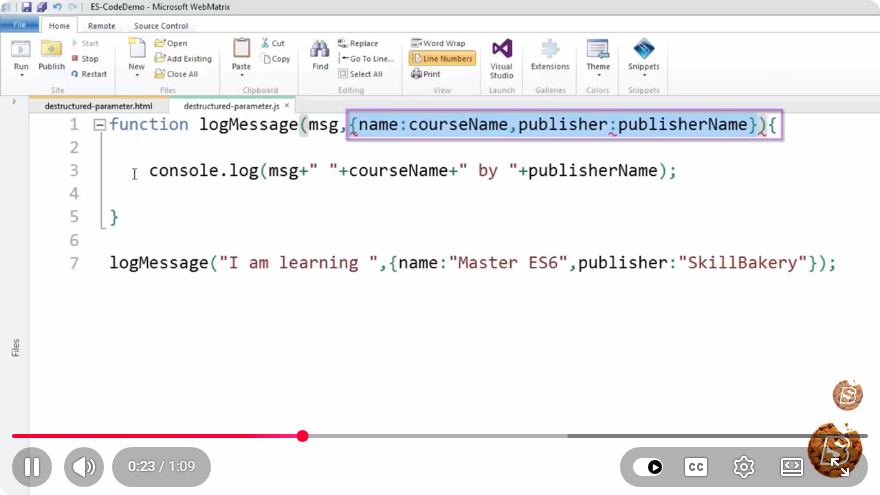
Instead of passing the entire object and then accessing its properties within the function, you can destructure it directly in the function parameters:
Example: Basic Object Destructuring
function printUser({ name, age, email }) {
    console.log(`Name: ${name}`);
    console.log(`Age: ${age}`);
    console.log(`Email: ${email}`);
}

printUser(user);
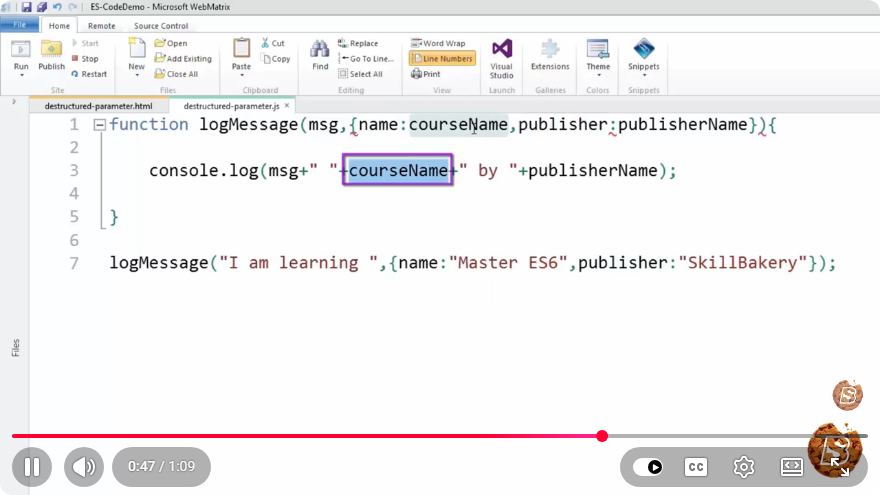
In the above example, the printUser function takes an object and directly extracts the name, age, and email properties. This eliminates the need for additional lines to access these properties, making the code cleaner.
Destructuring with Default Values
Destructuring also allows you to set default values for parameters. This is particularly useful when you’re dealing with optional properties:
Example: Default Values
function printUser({ name, age, email = 'Not Provided' } = {}) {
    console.log(`Name: ${name}`);
    console.log(`Age: ${age}`);
    console.log(`Email: ${email}`);
}

printUser({ name: 'Jane Doe', age: 25 }); // Email will default to 'Not Provided'
In this example, if the email property is not provided, it defaults to "Not Provided". Additionally, the function can still handle cases where no argument is passed at all, as we've set a default empty object.
Destructuring Array Parameters
Destructuring can also be applied to arrays in function parameters. This is useful when you want to pass multiple values in a more organized way.
Example: Array Destructuring
function calculateTotal([item1, item2, item3]) {
    return item1 + item2 + item3;
}

const items = [10, 20, 30];
console.log(calculateTotal(items)); // Output: 60
In this example, the calculateTotal function takes an array as an argument and destructures it directly into individual parameters.
Conclusion
Destructuring parameters in JavaScript ES6 is a powerful feature that enhances the way we handle function arguments. By using destructuring, developers can write cleaner, more readable code, and manage object and array parameters efficiently. This technique is especially useful in modern web development, where managing data structures is a common task.
As you dive deeper into JavaScript, consider implementing destructuring in your own projects. It will not only streamline your code but also lead to better practices in function design. Happy coding!
Connect with SkillBakery Studios
Explore more tutorials, tools, and resources:
Posted by SkillBakery Studios


 Hello, my name is Jack Sparrow. I'm a 50 year old self-employed Pirate from the Caribbean.
No comments:
Post a Comment