
JavaScript - Exploring Some and Every method for array objects
Exploring JavaScript's some and every Methods for Array Objects
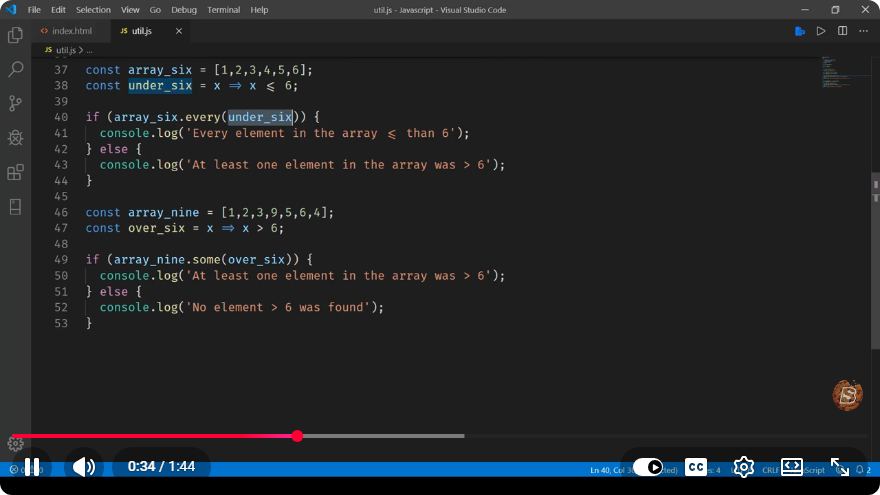
In the world of JavaScript, arrays are fundamental data structures that allow you to store and manipulate collections of items. Among the many array methods available, some and every stand out for their utility in testing conditions across array elements. In this post, we'll explore how these methods work, their syntax, and practical examples to illustrate their functionality.
What are some and every?
The some and every methods are used to check whether certain conditions hold true for the elements of an array.
some: This method tests whether at least one element in the array passes the test implemented by the provided function. It returnstrueif the callback function returns a truthy value for any array element; otherwise, it returnsfalse.every: This method tests whether all elements in the array pass the test implemented by the provided function. It returnstrueif the callback function returns a truthy value for every array element; otherwise, it returnsfalse.
Syntax
some Syntax
array.some(callback(element[, index[, array]])[, thisArg])
- callback: A function that is executed for each element in the array until it finds one where the function returns
true. - thisArg (optional): Value to use as
thiswhen executing the callback.
every Syntax
array.every(callback(element[, index[, array]])[, thisArg])
- callback: A function that is executed for each element in the array until it finds one where the function returns
false. - thisArg (optional): Value to use as
thiswhen executing the callback.
Practical Examples
Let’s dive into some practical examples to see these methods in action.
Using some
Imagine you have an array of numbers, and you want to check if there are any even numbers in the array.
const numbers = [1, 3, 5, 8, 11];

const hasEven = numbers.some(num => num % 2 === 0);

console.log(hasEven); // Output: true
In this example, some checks each number in the array. Since 8 is even, the method returns true.
Using every
Now, let’s look at an example using every. Suppose you want to check if all the numbers in an array are positive.
const numbers = [1, 2, 3, 4, -5];

const allPositive = numbers.every(num => num > 0);

console.log(allPositive); // Output: false
Here, every checks each number in the array. Because -5 is not positive, the method returns false.
When to Use some and every
- Use
somewhen you want to verify if at least one element meets a particular condition. - Use
everywhen you need to ensure that all elements meet a certain condition.
Both methods can be very helpful in scenarios such as form validation, filtering data, or checking specific conditions in applications.
Conclusion
The some and every methods are powerful tools in JavaScript that enhance the way we interact with arrays. Understanding when and how to use these methods can simplify your code and make it more readable. As you continue your journey with JavaScript, keep these methods in your toolkit for effective array manipulation.
Feel free to explore these methods further and experiment with different conditions using example arrays. Happy coding!
Connect with SkillBakery Studios
Explore more tutorials, tools, and resources:
Posted by SkillBakery Studios


 Hello, my name is Jack Sparrow. I'm a 50 year old self-employed Pirate from the Caribbean.
No comments:
Post a Comment