
JavaScript - Immediately Invoked Function Expression
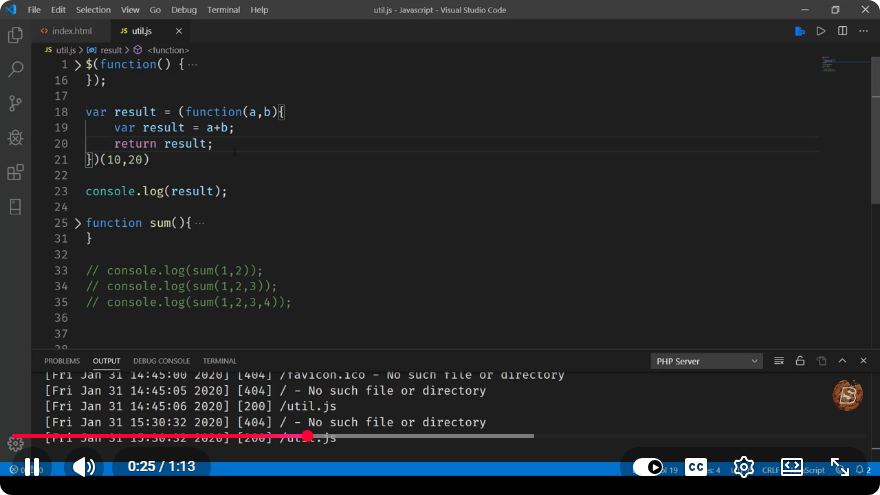
Understanding Immediately Invoked Function Expressions (IIFE) in JavaScript
JavaScript is a versatile programming language that allows developers to use various patterns to create efficient and maintainable code. One of these patterns is the Immediately Invoked Function Expression (IIFE). In this blog post, we'll explore what an IIFE is, why it's useful, and how to implement it in your JavaScript code.
What is an IIFE?
An Immediately Invoked Function Expression (IIFE) is a JavaScript function that runs as soon as it is defined. The primary purpose of using an IIFE is to create a new scope for variables, which helps avoid polluting the global namespace. This is particularly useful in large applications or when working with libraries to prevent conflicts between variable names.
Syntax of an IIFE
The syntax for an IIFE is straightforward. It involves wrapping a function in parentheses and immediately invoking it. Here’s the basic structure:
(function() {
    // Code to be executed
})();
You can also define an IIFE using arrow functions, which can make your code more concise:
(() => {
    // Code to be executed
})();
Why Use an IIFE?
1. Scope Management
One of the biggest advantages of using an IIFE is scope management. In JavaScript, variables defined in a function are not accessible outside of that function. By using an IIFE, you can create private variables that are not exposed to the global scope.
var globalVar = "I'm global!";

(function() {
    var localVar = "I'm local!";
    console.log(localVar); // Outputs: I'm local!
})();

console.log(globalVar); // Outputs: I'm global!
console.log(localVar); // ReferenceError: localVar is not defined
2. Avoiding Global Namespace Pollution
When developing larger applications or working with multiple libraries, you can inadvertently overwrite global variables. IIFEs help encapsulate your code and avoid this issue.
3. Module Pattern
IIFEs are commonly used in the module pattern, allowing developers to create modules that encapsulate functionality. This pattern can help organize code and enhance reusability.
var myModule = (function() {
    var privateVar = "I'm private!";

    return {
        getPrivateVar: function() {
            return privateVar;
        }
    };
})();

console.log(myModule.getPrivateVar()); // Outputs: I'm private!
console.log(myModule.privateVar); // Undefined
Practical Example of IIFE
Let's look at a practical example where we can see an IIFE in action. Imagine you want to create a simple counter that can increment or decrement without exposing its internal state to the global scope.
var counter = (function() {
    var count = 0; // Private variable

    return {
        increment: function() {
            count++;
            console.log(count);
        },
        decrement: function() {
            count--;
            console.log(count);
        }
    };
})();

counter.increment(); // Outputs: 1
counter.increment(); // Outputs: 2
counter.decrement(); // Outputs: 1
In this example, count is a private variable that can't be accessed from outside the IIFE, ensuring that the counter's state remains encapsulated.
Conclusion
Immediately Invoked Function Expressions (IIFEs) are a powerful tool in JavaScript that enhance scope management and help avoid global namespace pollution. Understanding how to use IIFEs can improve the organization and maintainability of your code, especially in larger applications.
By encapsulating code within an IIFE, you gain the ability to create private variables and functions, making your JavaScript more modular and less prone to conflicts. Whether you're building a simple script or a complex application, IIFEs can serve as an invaluable pattern in your toolkit.
Happy coding!
Connect with SkillBakery Studios
Explore more tutorials, tools, and resources:
Posted by SkillBakery Studios


 Hello, my name is Jack Sparrow. I'm a 50 year old self-employed Pirate from the Caribbean.
No comments:
Post a Comment