
Master MEAN : Introduction to NoSQL - Web Development
Master MEAN: Introduction to NoSQL
In the rapidly evolving world of web development, understanding different database technologies is crucial for building robust applications. One such technology that has gained immense popularity is NoSQL. In this blog post, we will explore the fundamentals of NoSQL, particularly in the context of the MEAN stack, which comprises MongoDB, Express.js, Angular, and Node.js.
What is NoSQL?
NoSQL, which stands for "Not Only SQL," refers to a category of database management systems that are designed to handle a wide variety of data models. Unlike traditional relational databases that use structured query language (SQL) and fixed schemas, NoSQL databases allow for more flexibility in data storage and retrieval. Here are some key characteristics of NoSQL databases:
- Schema-less: NoSQL databases do not require a predefined schema, allowing developers to store unstructured or semi-structured data easily.
- Horizontal Scalability: They can be scaled horizontally by adding more servers, making them suitable for large datasets and high-traffic applications.
- Varied Data Models: NoSQL databases can support various data structures, including key-value pairs, documents, column-family stores, and graphs.
Why Choose NoSQL?
Flexibility
NoSQL databases offer a flexible data model, which is particularly beneficial for applications with rapidly changing requirements. Developers can easily adapt the database schema without significant overhead.
Performance
When dealing with large volumes of read and write operations, NoSQL databases often outperform traditional relational databases due to their ability to distribute data across multiple servers.
Scalability
As applications grow, the demand for scalability increases. NoSQL databases are designed to scale out efficiently, making it easier to manage large datasets and high traffic loads.
NoSQL in the MEAN Stack
The MEAN stack is a popular framework for building dynamic web applications. Each component of the MEAN stack plays a crucial role, but MongoDB, the NoSQL database, is particularly notable for its compatibility with JavaScript-based frameworks.
MongoDB
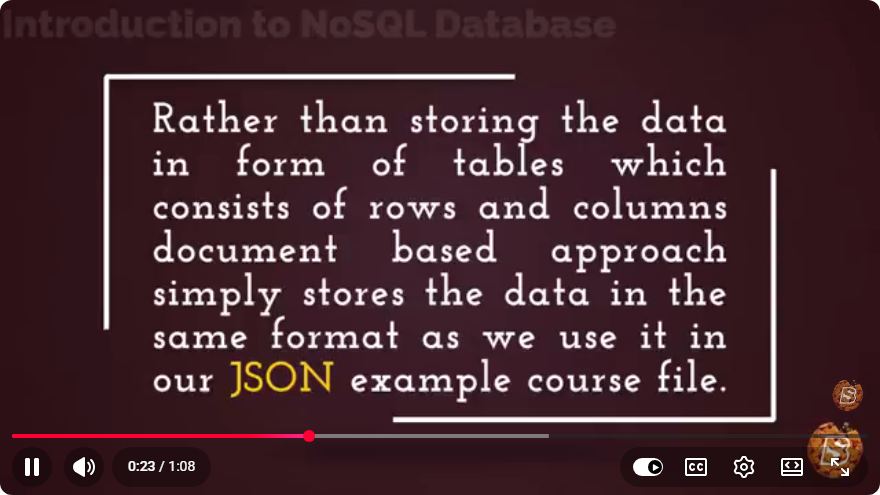
MongoDB is a document-oriented NoSQL database that stores data in JSON-like format, known as BSON (Binary JSON). This format allows for the representation of complex data structures and makes it easy to work with JavaScript objects.
Key Features of MongoDB
- Document Storage: Data is stored in documents, making it easy to organize and retrieve related information.
- Indexing: MongoDB supports various indexing strategies, improving query performance.
- Aggregation Framework: It provides powerful aggregation capabilities to analyze and transform data.
Setting Up MongoDB
To get started with MongoDB, follow these steps:
- Install MongoDB: You can download the MongoDB Community Server from MongoDB's official website.
- Start MongoDB: Launch the MongoDB server using the command:
mongod - Connect to MongoDB: Use the MongoDB shell to connect to your database:
mongo
Basic Operations with MongoDB
Here are some basic operations you can perform with MongoDB:
Creating a Database and Collection
To create a new database and collection, use the following commands in the MongoDB shell:
use myDatabase; // Create or switch to 'myDatabase'
db.createCollection('myCollection'); // Create 'myCollection'
Inserting Documents
You can insert documents into a collection using the insertOne or insertMany methods:
db.myCollection.insertOne({
    name: "John Doe",
    age: 30,
    hobbies: ["reading", "traveling"]
});
Querying Documents
To retrieve documents from the collection, use the find method:
db.myCollection.find({ age: { $gt: 25 } }); // Find documents where age > 25
Conclusion
In this introductory blog post, we’ve covered the essential aspects of NoSQL databases, focusing on MongoDB within the MEAN stack. The flexibility, performance, and scalability of NoSQL databases make them an excellent choice for modern web applications. As you dive deeper into the MEAN stack and NoSQL databases, you'll discover the powerful capabilities they offer for building dynamic and efficient web applications.
For further learning, consider exploring advanced topics such as MongoDB's aggregation framework, data modeling strategies, and integrating MongoDB with Express.js and Angular for full-stack development. Happy coding!
Connect with SkillBakery Studios
Explore more tutorials, tools, and resources:
Posted by SkillBakery Studios


 Hello, my name is Jack Sparrow. I'm a 50 year old self-employed Pirate from the Caribbean.
No comments:
Post a Comment