
Python - Learn in place swapping
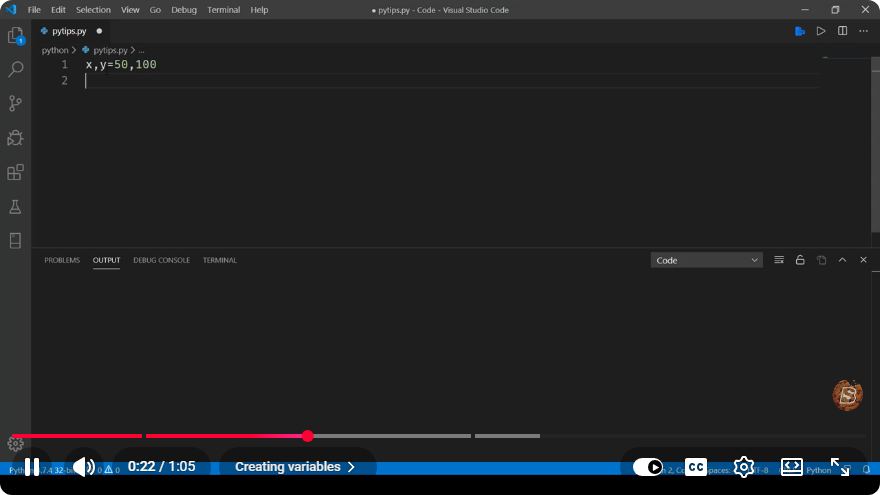
In-Place Swapping in Python: A Quick Guide
Swapping values in Python can be done in various ways, but one of the most efficient methods is through in-place swapping. This tutorial will provide you with a clear understanding of how in-place swapping works in Python, including a brief exploration of its advantages and practical examples. Let's get started!
What is In-Place Swapping?
In-place swapping refers to changing the values of two variables without using an additional temporary variable. This technique is particularly useful for reducing memory usage and improving performance, especially in larger data sets.
Basic Syntax of In-Place Swapping
In Python, we can achieve in-place swapping with a simple syntax that leverages tuple unpacking. Here’s the basic structure:
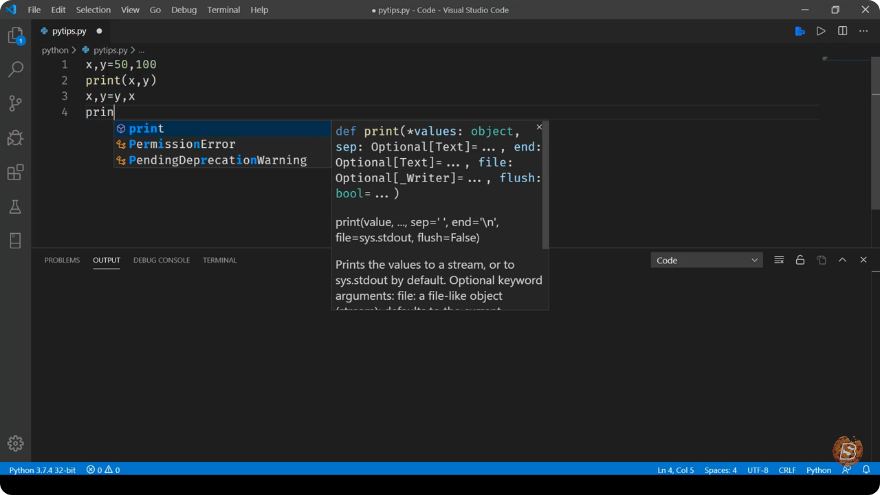
a, b = b, a
This line simultaneously assigns the value of b to a and the value of a to b, effectively swapping their values.
Example of In-Place Swapping
Let’s look at a practical example to illustrate how in-place swapping works:
# Initial values
a = 5
b = 10

print(f"Before swapping: a = {a}, b = {b}")

# Swapping values
a, b = b, a

print(f"After swapping: a = {a}, b = {b}")
Output
Before swapping: a = 5, b = 10
After swapping: a = 10, b = 5
Explanation of the Example
- We start by initializing two variables,
aandb, with values5and10, respectively. - We print the values of
aandbbefore swapping. - Using the in-place swapping technique, we swap the values of
aandbin a single line. - Finally, we print the swapped values.
Advantages of In-Place Swapping
- Memory Efficiency: In-place swapping does not require an additional variable, which saves memory.
- Readability: The syntax is clean and easy to understand, making the code more readable.
- Performance: Swapping values using tuple unpacking is often faster than using a temporary variable, especially in large datasets.
When to Use In-Place Swapping
In-place swapping is particularly useful in scenarios where:
- You are dealing with a large number of variables and wish to optimize memory usage.
- You want to write clean and efficient code without the overhead of additional assignments.
Conclusion
In-place swapping is a powerful technique in Python that allows you to swap values efficiently and concisely. It is a useful skill to master, particularly for those looking to optimize their code. With the simple syntax of tuple unpacking, you can easily implement this technique in your programming tasks.
For more advanced applications, consider exploring how in-place swapping can be utilized in sorting algorithms or other data manipulation techniques. Happy coding!
Connect with SkillBakery Studios
Explore more tutorials, tools, and resources:
Posted by SkillBakery Studios


 Hello, my name is Jack Sparrow. I'm a 50 year old self-employed Pirate from the Caribbean.
No comments:
Post a Comment