
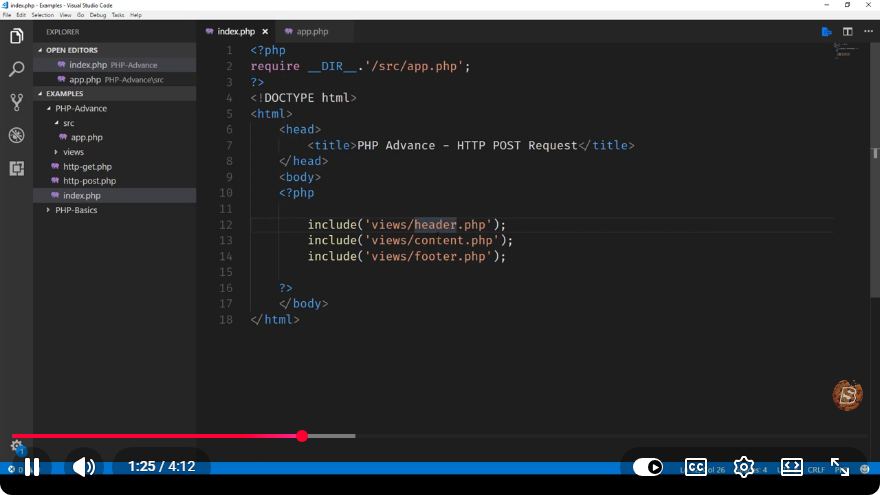
Web Development - PHP Advance : Require
Mastering Advanced PHP: A Comprehensive Guide
In the world of web development, PHP remains one of the most powerful and widely-used server-side scripting languages. This blog post will delve into advanced PHP concepts, building on the foundational knowledge you may already possess. Drawing inspiration from the YouTube video titled "Web Development - PHP Advance," we aim to provide a structured and detailed tutorial to enhance your PHP skills.
Understanding Advanced PHP Concepts
Advanced PHP programming allows developers to create more efficient, scalable, and maintainable web applications. Below are some of the key topics we will cover:
1. Namespaces
Namespaces help avoid name collisions in larger applications by encapsulating classes, functions, and constants. They are particularly useful when integrating third-party libraries.
Example:
namespace MyProject\Utilities;

class Logger {
    public static function log($message) {
        echo "[LOG] " . $message;
    }
}
To use the Logger class, you would reference it with its full namespace:
$logger = new \MyProject\Utilities\Logger();
$logger::log('This is a namespaced log message.');
2. Traits
Traits are a mechanism for code reuse in PHP. They allow you to include methods from multiple classes without the need for inheritance.
Example:
trait Loggable {
    public function log($message) {
        echo "[LOG] " . $message;
    }
}

class User {
    use Loggable;

    public function createUser($username) {
        $this->log("User {$username} created.");
    }
}
3. Generators
Generators provide an easy way to implement simple iterators. They allow you to iterate over a set of data without needing to create an array in memory.
Example:
function numberGenerator() {
    for ($i = 1; $i <= 5; $i++) {
        yield $i;
    }
}

foreach (numberGenerator() as $number) {
    echo $number . PHP_EOL;  // Outputs 1, 2, 3, 4, 5
}
4. Exception Handling
Advanced error handling is crucial for building robust applications. PHP provides a powerful mechanism for handling exceptions, allowing you to manage errors gracefully.
Example:
try {
    throw new Exception("An error occurred.");
} catch (Exception $e) {
    echo "Caught exception: " . $e->getMessage();
}
5. PDO for Database Interactions
Using PHP Data Objects (PDO) allows for a secure and efficient way to interact with databases. PDO supports various databases and offers prepared statements to prevent SQL injection.
Example:
try {
    $pdo = new PDO('mysql:host=localhost;dbname=test', 'user', 'password');
    $stmt = $pdo->prepare("SELECT * FROM users WHERE id = :id");
    $stmt->execute(['id' => 1]);
    $user = $stmt->fetch();
    print_r($user);
} catch (PDOException $e) {
    echo "Database error: " . $e->getMessage();
}
Best Practices for Advanced PHP Development
As you explore advanced PHP features, consider these best practices to ensure your code remains maintainable and efficient:
- Follow PSR Standards: Adhering to PHP-FIG's PSR standards enhances code consistency and readability.
- Use Composer: Leverage Composer for dependency management to keep your libraries up-to-date and avoid conflicts.
- Implement Unit Testing: Use PHPUnit to write tests for your code, ensuring reliability and facilitating future changes.
- Optimize Performance: Profile your PHP applications to identify bottlenecks and optimize performance accordingly.
Conclusion
Advanced PHP programming opens up a world of possibilities, allowing you to create sophisticated web applications. By understanding concepts like namespaces, traits, generators, exception handling, and PDO, you can enhance your development skills and improve your projects' architecture.
For more insights and practical examples, consider watching the full tutorial on YouTube titled "Web Development - PHP Advance." Happy coding!
Connect with SkillBakery Studios
Explore more tutorials, tools, and resources:
Posted by SkillBakery Studios


 Hello, my name is Jack Sparrow. I'm a 50 year old self-employed Pirate from the Caribbean.
No comments:
Post a Comment