
TypeScript : What this course covers - Web Development 42 seconds
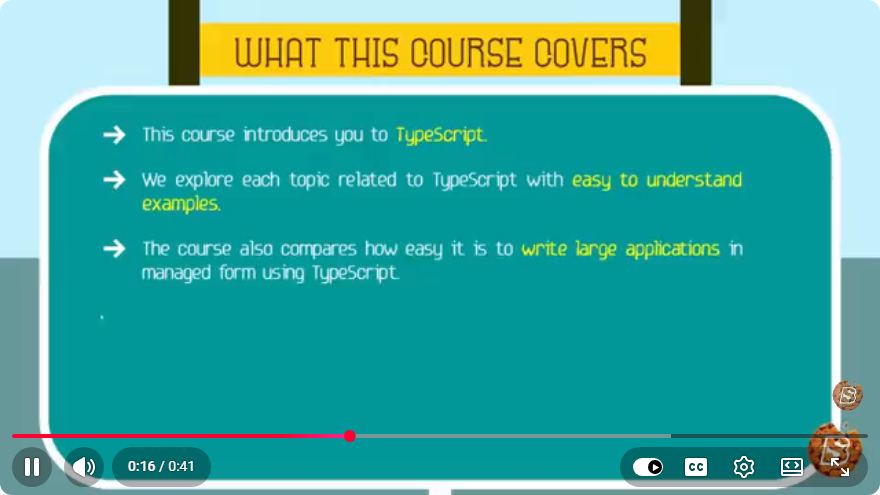
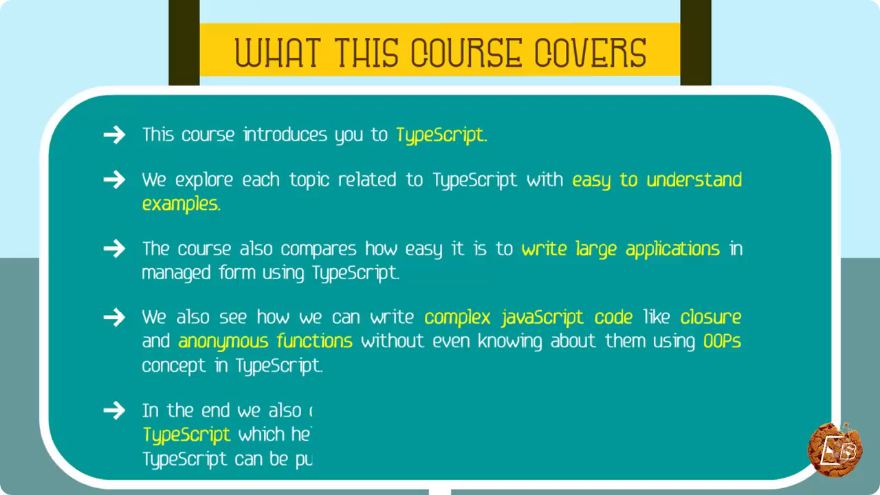
TypeScript: What This Course Covers
In the rapidly evolving landscape of web development, TypeScript has emerged as a robust superset of JavaScript that enhances development efficiency, maintainability, and scalability. If you are considering taking a TypeScript course, you might be wondering what to expect. In this post, we will delve into the key topics and concepts covered in a typical TypeScript course, providing you with a comprehensive overview to set you on the right path.
What is TypeScript?
TypeScript is an open-source programming language developed by Microsoft. It builds upon JavaScript by adding static types, which can help catch errors at compile time rather than at runtime. This feature is particularly beneficial for large-scale applications where understanding and managing complex codebases can be challenging.
Course Overview
A well-structured TypeScript course typically covers the following core areas:
1. Introduction to TypeScript
What is TypeScript?
Understand the origins and evolution of TypeScript, and how it fits into the JavaScript ecosystem.Installation and Setup
Learn how to install TypeScript via npm and set up your development environment.
2. Basic Types
Primitive Types
Explore the various primitive types in TypeScript, includingnumber,string,boolean,null, andundefined.Arrays and Tuples
Understand how to work with arrays and tuples, and how they differ in TypeScript compared to JavaScript.Enums
Discover how to use enums to define named constants, which can improve code readability.
3. Interfaces and Types
Defining Interfaces
Learn how to create interfaces to define the shape of an object, allowing for better type-checking.Type Aliases
Understand how to create type aliases to simplify complex type definitions and enhance code clarity.
4. Functions and Method Overloading
Function Types
Explore how to define types for functions and understand the importance of specifying parameter and return types.Method Overloading
Learn how to overload methods in TypeScript to create functions that can accept different types of parameters.
5. Classes and Object-Oriented Programming
Class Syntax
Gain insights into TypeScript's class syntax, including constructors, properties, and methods.Inheritance and Interfaces
Understand how to extend classes and implement interfaces to create reusable and maintainable code.
6. Advanced Types
Union and Intersection Types
Learn how to use union and intersection types to create more flexible data structures.Type Guards
Explore type guards and how they can help refine types at runtime.
7. Generics
Understanding Generics
Delve into generics and their advantage in creating reusable components and functions.Generic Constraints
Learn how to apply constraints to generics to enforce type requirements.
8. Modules and Namespaces
Module System
Understand TypeScript's module system for organizing code and managing dependencies effectively.Namespaces
Explore how namespaces can help in grouping related code and avoiding naming conflicts.
9. Configuration and Compilation
tsconfig.json
Learn about thetsconfig.jsonfile, which allows you to configure various compiler options for your TypeScript projects.Compiling TypeScript
Understand the compilation process from TypeScript to JavaScript and how to use the TypeScript compiler (tsc).
10. Integrating with JavaScript Frameworks
- React, Angular, and Vue
Discover how TypeScript integrates seamlessly with popular JavaScript frameworks, enhancing type safety and developer experience.
Conclusion
Taking a TypeScript course can significantly enhance your web development skills by providing you with a solid grounding in both TypeScript and its applications in modern frameworks. By the end of the course, you should feel confident in utilizing TypeScript to build robust, scalable, and maintainable web applications.
As you embark on this learning journey, remember to practice consistently and apply what you learn through real-world projects. Happy coding!
Connect with SkillBakery Studios
Explore more tutorials, tools, and resources:
Posted by SkillBakery Studios


 Hello, my name is Jack Sparrow. I'm a 50 year old self-employed Pirate from the Caribbean.
No comments:
Post a Comment