
Web Development : PHP Basics - Operators
Understanding PHP Operators: A Beginner's Guide
Web development has become an essential skill in today's digital landscape, and understanding PHP (Hypertext Preprocessor) is a crucial part of that journey. In this post, we’ll delve into the basics of PHP operators, a fundamental concept that you'll encounter frequently as you develop web applications.
What are Operators in PHP?
In PHP, operators are special symbols or keywords that perform operations on variables and values. They can manipulate data, perform calculations, and control program flow. Understanding how to use these operators will allow you to write more efficient and effective PHP scripts.
Types of Operators
PHP supports several types of operators, each serving different purposes. Here’s a breakdown of the most common ones:
- Arithmetic Operators
- Assignment Operators
- Comparison Operators
- Logical Operators
- String Operators
- Array Operators
Let’s explore each of these categories in detail.
1. Arithmetic Operators
Arithmetic operators are used to perform mathematical calculations. Here are the most common ones:
| Operator | Description | Example |
|---|---|---|
+ |
Addition | 5 + 3 |
- |
Subtraction | 5 - 3 |
* |
Multiplication | 5 * 3 |
/ |
Division | 5 / 3 |
% |
Modulus (Remainder) | 5 % 3 |
Example
<?php
$a = 10;
$b = 20;
echo $a + $b; // Outputs 30
?>
2. Assignment Operators
Assignment operators are used to assign values to variables. The standard assignment operator is =. However, PHP provides several compound assignment operators that combine assignment with arithmetic operations.
| Operator | Description | Example |
|---|---|---|
= |
Assign | $a = 5 |
+= |
Add and assign | $a += 5 |
-= |
Subtract and assign | $a -= 5 |
*= |
Multiply and assign | $a *= 5 |
/= |
Divide and assign | $a /= 5 |
Example
<?php
$a = 5;
$a += 3; // Now $a is 8
echo $a; // Outputs 8
?>
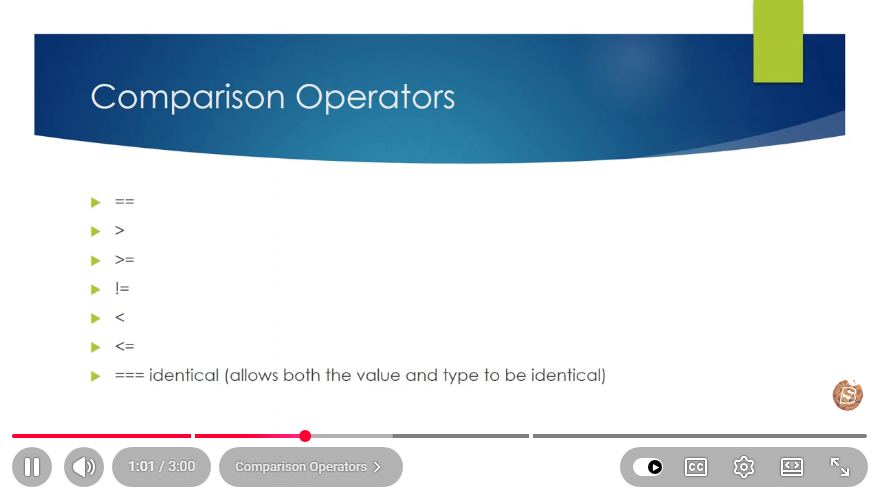
3. Comparison Operators
Comparison operators are used to compare two values. These operators return a boolean value: true or false.
| Operator | Description | Example |
|---|---|---|
== |
Equal | 5 == 5 |
=== |
Identical (same type) | 5 === '5' |
!= |
Not equal | 5 != 3 |
!== |
Not identical | 5 !== '5' |
< |
Less than | 5 < 10 |
> |
Greater than | 10 > 5 |
Example
<?php
$a = 5;
$b = '5';
var_dump($a == $b);  // true
var_dump($a === $b); // false
?>
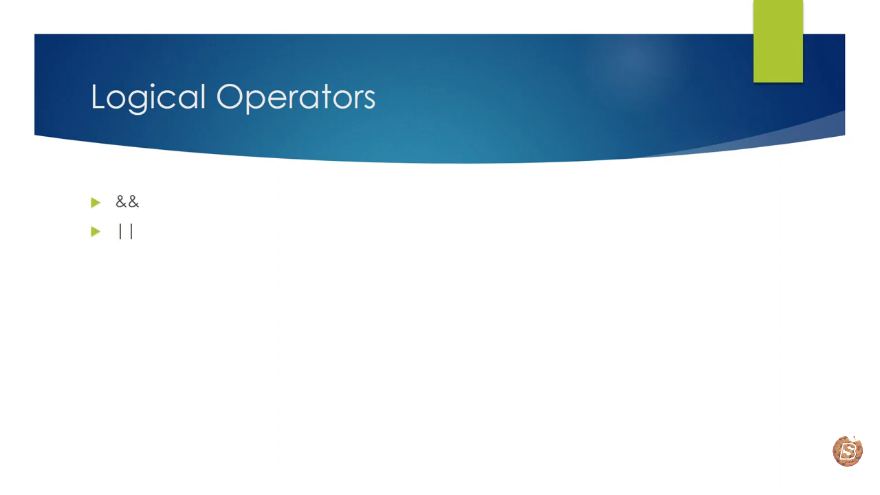
4. Logical Operators
Logical operators are used to combine conditional statements. They are mainly used in control structures such as if statements.
| Operator | Description | Example |
|---|---|---|
&& |
And | ($a > $b && $c > $d) |
| ` | ` | |
! |
Not | !($a > $b) |
Example
<?php
$a = true;
$b = false;
var_dump($a && $b); // Outputs false
?>
5. String Operators
String operators are used to concatenate strings. PHP has two string operators:
| Operator | Description | Example |
|---|---|---|
. |
Concatenation | "Hello " . "World" |
.= |
Concatenation assignment | $a .= "World"; |
Example
<?php
$greeting = "Hello ";
$greeting .= "World!";
echo $greeting; // Outputs Hello World!
?>
6. Array Operators
Array operators are used to compare arrays. They help in determining the relationship between two arrays.
| Operator | Description | Example |
|---|---|---|
+ |
Union | $array1 + $array2 |
== |
Equality | $array1 == $array2 |
=== |
Identity | $array1 === $array2 |
Example
<?php
$array1 = array("a" => "apple", "b" => "banana");
$array2 = array("a" => "apple", "b" => "banana");

var_dump($array1 == $array2); // Outputs true
?>
Conclusion
Understanding operators in PHP is essential for any web developer. The right use of arithmetic, assignment, comparison, logical, string, and array operators will enhance your coding efficiency and allow you to create more complex applications. As you practice these operators, you'll find yourself building more dynamic and interactive web applications with ease.
For further learning, consider experimenting with PHP code snippets in your local development environment. Happy coding!
Connect with SkillBakery Studios
Explore more tutorials, tools, and resources:
Posted by SkillBakery Studios


 Hello, my name is Jack Sparrow. I'm a 50 year old self-employed Pirate from the Caribbean.
No comments:
Post a Comment